O Come O Come Emmanuel
By Caleb Doyle
Like many Sufjan Stevens fans, I first discovered his music from someone in my youth group at church. Also, like many of those same people, I’m further than I’ve ever been from my Church Era. At nearly 32 years old, I reckon with that version of myself often — the feelings of guilt and shame, even the immense gratitude I feel about that time and where I am now. That guilt grows larger around the holidays.
We started going to church mostly because Grandma wanted us to. My grandparents, Don and Janice, were devout Christians who grew up in post-Depression Missouri. Grandma Jan was serious about the routine of attending church — what to wear, where to sit, how to focus. Grandpa Don was a legitimate Bible scholar. I remember tagging along to their Senior Citizens Bible Study class on Sunday mornings (I hated the puppetry and goofy songs in Children’s Church. I think even as a nine-year-old I felt it was beneath me. God, I was so annoying). I witnessed how revered my grandpa was in that class. He could reference Bible verses with no hesitation and knew even the obscure characters well. He loved telling me about how Methusaleh lived to be 969 years old.
Once I got a bit older and into the youth group, I began to genuinely enjoy attending and being involved. The older kids, some of whom I still consider lifelong friends, showed me all the cool Christian music of the time: Relient K, Five Iron Frenzy, TobyMac and DC Talk, Family Force Five. Some of those acts weren’t explicitly Christian but were approved because of their spiritual themes and the fact that they didn’t cuss. Relient K became a gateway to Fall Out Boy, and I was soon admonished for listening to “secular music.” Pretty much as soon as I could drive, I was out and never looked back.
Except I looked back constantly. I still look back. Every year when the weather starts to chill, the lights go up, and the hymns get co-opted for Amazon commercials, I think about that time in my life. More often than not, I look back fondly and remember the elaborate Christmas pageants, and our family insisting that I read Matthew Chapters 1 and 2 before we opened presents. But sometimes I’m wracked with guilt for leaving the church, and filled with what-ifs about who I would have been had I stayed. Had I not “turned my back on God,” as the church elders would have called it.
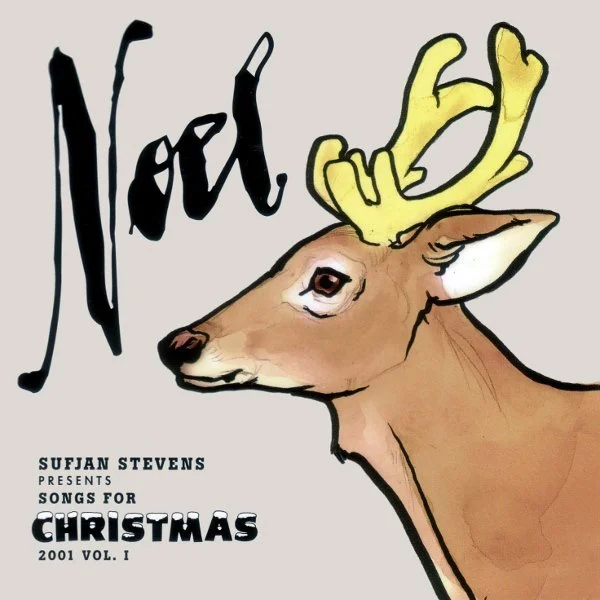
And that’s the dynamic of Sufjan Stevens. Throughout his entire catalog, especially on his Songs for Christmas collection, Stevens has balanced the jubilant with the somber. Stevens is a pro at punching the listener right in the gut with tragedy immediately after something upbeat. Just take Illinois, when he follows “Come On! Feel the Illinoise!” with “John Wayne Gacy, Jr.” The second song on Songs for Christmas, “O Come O Come Emmanuel,” is a distillation of Stevens at his most mournful. In the scope of a Christmas collection, it slots perfectly as a balm to all the puppetry and goofiness of something like the celebratory “Joy to the World” — BLECCH! (I think I’ve always been the Ebeneezer Scrooge in my own life.)
“O Come O Come Emmanuel” is a dirge-y lament, a crying-out to God from a great nation, beckoning for salvation. The first two lines deserve a bit of dissection. It begins: “O Come, O Come, Emmanuel,” Emmanuel meaning “God with us.” The following lyric: “And ransom captive Israel,” aka the Christ child, God made flesh, dear eight-pound, six-ounce baby Jesus, who was promised to be the sacrifice sent from heaven to Earth to save the people from their sins and secure their entry into eternity. It’s a reference to Isaiah 35:10 and Jeremiah 31:11. In these passages, the prophets speak of Israel in exile and the redemption the Lord performed to free them from Egypt. But at this point, Israel was experiencing a sort of spiritual bondage — sin and sorrow and hatred. Bible lesson aside, it’s a heavy, heavy song, but it speaks to the gravity of the Biblical Christmas. The Savior of the Universe was just born. Stevens, with little more than a banjo, some woodwinds, a chorus of voices, and some drums, does justice to the gravity of the material.
That’s what makes this version of “O Come O Come Emmanuel” so special to me. It totally captures the feeling of inner turmoil that the holidays cause me now. I feel hopeful and happy and Holly Jolly, and there’s a sheen of spiritual yearning shellacked on everything.
Caleb Doyle (St. Louis, MO) is a music writer and dive bar enthusiast. He would love to talk to you about pro wrestling, your favorite cheeseburger, and your top 10 American rock bands. You can find Caleb on most social media (@ClassicDoyle) and subscribe to his music Substack, Nightswimming.