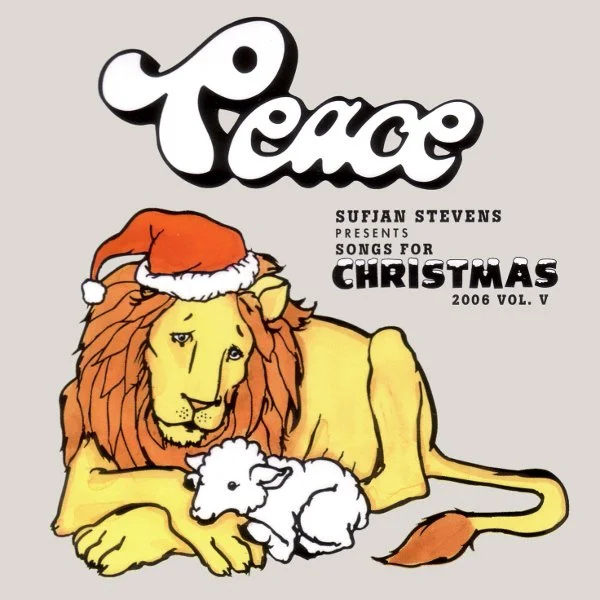
Holy, Holy, Holy
By Ben Sooy
My buddy Ryan saw Sufjan Stevens live back in 2006. Before the show started, a couple of guys around Ryan were getting impatient, and one asked, “Where is Sufjan??”
“He’s probably backstage praying,” the other responded.
“What do you mean?”
“You know he’s, like, very Christian.” He put his hands up in a placating gesture, “But it’s cool! It’s cool!”
Being a Christian has never, in the history of my life, felt particularly cool. It has felt mainstream (which is very uncool) and at times it has felt niche and weird, but not like in a cool, sexy way. Going to church, being a part of a strange (often problematic) subculture: it all feels vaguely embarrassing and maybe requires some explanation, like your girlfriend meeting your extended family for the first time.
Sufjan Stevens was one of the first artists I ever encountered who was a) actually cool; b) making explicitly Christian songs; c) making songs that are honest, personal, and actually very good. He was himself. And it wasn’t actually primarily Christian culture that liked him. It was cool music magazines, cool music websites, and other cool musicians you liked. I don’t know how to explain what a big deal this was to me.
Much of the Christian music of my childhood was well-intentioned but a little ugly. Or too over the top. But it was also kind of special in its longing for beauty. I would sometimes go with friends to the youth group at the evangelical mega church, but on most Sundays, my grandma took me to our small Episcopal church of maybe 30 people. Our priest, Father David, was a gifted jazz pianist who gathered a really eclectic group of musicians, and I was one of them. I was learning guitar, and he let me cut my chops playing acoustic at church with a group of musicians that often outnumbered the non-musician attendees. I’m sure I wasn’t very good, but I got to participate, and honestly, playing music at church was a thing that helped me immensely as a developing musician and human being.
Interestingly, Sufjan himself often shied away from calling his music “Christian.” In a 2006 interview he said, “On an aesthetic level, faith and art are a dangerous match. Today, they can quickly lead to devotional artifice or didactic crap. This would summarize the Christian publishing world or the Christian music industry.” But honestly, like an emo band that refused to call themselves emo, this made me love his music all the more. If memory serves, my roommate at Bible college burned me copies of Illinois and the early Christmas EPs. My world was never the same.
I thank God for three specific non-Christmas songs that Sufjan chose to record for Songs for Christmas, his first multi-volume holiday collection. “Amazing Grace,” “Come Thou Found Of Every Blessing,” and “Holy, Holy, Holy” are not historically associated with Advent or the Christmas season at all; they’re just hymns you’ll find on any old Sunday. I’ve sung these countless times at church and at home, and yet, the definitive version that lives in my head for each of them is Sufjan’s.
The one I really want to talk about is “Holy, Holy, Holy” — a song that sinks or swims for me, depending on who’s singing it. I’ve heard so many schmaltzy, over-the-top versions. Much love to Amy Grant, but she gave “Holy Holy Holy” strings and key changes and slowed it down to a plodding march. Stephen Curtis Chapman gave it a modern CCM treatment, but it was still plodding! Still marching! No soul!! No angst!!
I think the main musical mistake believers make when singing “Holy, Holy, Holy” is that we try to make it triumphant. White American Christianity loves Victory and Triumph. Every song must be an upbeat banger. We turn it into a military march with all the pomp and circumstance of the U.S. national anthem (which, we can all agree, is a truly awful and unsingable song).
But Jesus Christ only promises new life on the other side of death and desolation, which is why it feels right to me that Sufjan’s “Holy” is filled with yearning. Though, to be fair, try to name a Sufjan song not filled to the brim with yearning!
Holy, Holy, Holy! Though the darkness hide Thee,
Though the eye of sinful man, thy glory may not see:
Only Thou art holy, there is none beside Thee,
Perfect in power, in love, and purity.
Sufjan’s yearning, to me, is more in keeping with the original thought of the song. The lyrics are adapted from a moment in Isaiah 6:
In the year that King Uzziah died, I saw the Lord sitting upon a throne, high and lifted up; and the train of his robe filled the temple. Above him stood the seraphim. Each had six wings: with two he covered his face, and with two he covered his feet, and with two he flew. And one called to another and said:
“Holy, holy, holy is the Lord of hosts; the whole earth is full of his glory!”
And the foundations of the thresholds shook at the voice of him who called, and the house was filled with smoke. And I said: “Woe is me! For I am lost; for I am a man of unclean lips, and I dwell in the midst of a people of unclean lips; for my eyes have seen the King, the Lord of hosts!”
Then one of the seraphim flew to me, having in his hand a burning coal that he had taken with tongs from the altar. And he touched my mouth and said: “Behold, this has touched your lips; your guilt is taken away, and your sin atoned for.”
If I saw God, in person, in His strange glory, flocked by biblically accurate angels with six wings, I think this would be my response too. I was not prepared for this. I gotta get out of here.
There’s a moment in C.S. Lewis’ Perelandra where he meets an angel face-to-face:
“I felt sure that the creature was what we call ‘good,’ but I wasn’t sure whether I liked ‘goodness’ so much as I had supposed. This is a very terrible experience… Here at last was a bit of that world from beyond the world, which I had always supposed that I loved and desired, breaking through and appearing to my senses: and I didn’t like it, I wanted it to go away. I wanted every possible distance, gulf, curtain, blanket, and barrier to be placed between it and me.”
You get my point. It just feels inappropriate to me to take very strange and large concepts (God in Three Persons, a Messiah who dies, resurrection through crucifixion) and turn them into a national anthem.
A few musical observations: Sufjan plays “Holy, Holy, Holy” in 6/8 instead of the more traditional march in 4/4. If you’re not a musician and have no idea what I’m talking about, that’s okay! Listen to the instrumental “Holy, Holy, Etc.” from the EP Noel (which is in 4/4) and tell me it doesn’t feel kind of silly compared to Peace’s “Holy, Holy, Holy,” which is played dead serious. Sufjan also adds in way more minor chords than the traditional arrangement. Gentle fingerpicked acoustic guitar, piano, and two voices are mainly the instruments. There’s a loneliness and a complexity to the music that’s often missing from most Sunday Morning Songs.
I don’t exactly know if I can fully express why Sufjan’s “Holy, Holy, Holy” lands the way it does with me. Maybe it’s his gentleness, his restraint, and the context of the painful life Sufjan has lived. He gives a performance that points to the emotional core of the lyrics: a mixture of adoration and fear, love and desolation. Discomfort and comfort. God as Alien Other and Beloved Friend. I can’t articulate it fully, but there’s a reason why every year Songs for Christmas goes on the turntable after Thanksgiving and stays on repeat until New Year’s Day.
Ben Sooy is based in Denver, Colorado. He founded Holy Fool, a nonprofit community that supports independent working musicians. He plays guitar and sings songs with his best friends in Denver Emo Band A Place For Owls.