Lo! How A Rose E'er Blooming
By Michele Somerville
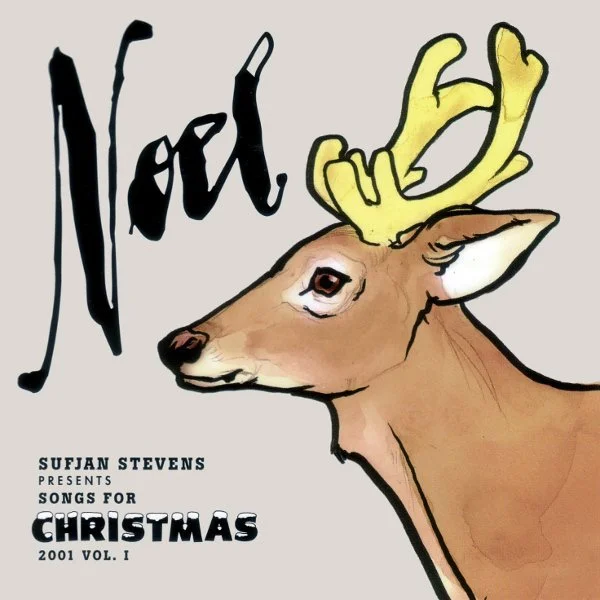
As I tried to figure out how to begin to try to say something about Sufjan’s Christmas “oeuvre,” — “oeuvre” I thought, maybe as “ere” a rose ere turning in the direction of light, I turned to “A Note of Explanation by Sufjan Stevens” for guidance. In that explanation, Sufjan asks whether “‘Silent Night’ and ‘Jingle Bells’ can be used as an exegesis for the big questions in life.” Why, yes, of course, I thought! But, only, perhaps, if the widest whole of Christmas sounds and words — (the scripture) is permitted to enter. Sufjan’s “ramshackle mixtape” epic is a form of “yes.” The Magnificat “yes” – the “My soul magnifies the Lord” yes, the LFG Christmas “yes.”
Sufjan calls his Christmas project “exegesis.” Exegetes explain scriptural texts, and Sufian’s is his epic assemblage of strains, bells, strings, sense memories, emotions pure and tainted, lights tinselly and starlight, all of which fall under the category of Christmas. Sufjan reaches into the cosmic Christmas stocking for every item he can retrieve and lets each explain itself via his song. Sufjan’s decision to include so many disparate kinds of songs feels like a form of prayer. The luxurious messiness of Sufjan’s catalog, and his seeming reluctance as both curator and musician, pleases me. It imitates the potential bounty of Christmas.
So many of the standards in the bunch of Sufjan Christmas songs are with us every year, whether we like it or not. Soldiers in foxholes sang them. Nearly every musician in the world who has ever made a record has sung them. Monastics sing them in abbeys. Blues singers play them in gin mills. They abound in films, annoy us in the supermarket, and make us cry in bars and churches. I think of the little casket in my grandmother’s New York City living room alongside the Christmas tree sometime in the early 1930s. What? One of your babies passed, and there was still Christmas? These songs help to heal us. We fall in love to them, through them, and with them.
I came to Sufjan already loving the song I wanted to write about. One of my favorite elements in Sufjan’s rendition of “Lo! How A Rose E’re Blooming” is the curious scheme of abrupt pauses. These vexed me the first few times I listened, but I quickly began to see that Sufjan had taken a 400-year-old Advent hymn Brahms re-arranged and used voice, tone, and time strategically to re-route the listener’s experience of it. I’ve heard a dozen versions of “Lo! How A Rose E’re Blooming” and loved each one, but this time Sufjan was showing me where to stop and be stunned. Something in the verse goes a little flat, the harmony breaks, and a kind of argument gets made. “It came a flower bright” is a gorgeous line of verse, but Sufjan sings it a little broken. Out of the pregnant pause that ensues comes something more than the pretty line.
“Lo! How A Rose E’re Blooming” is an Advent song, and Advent is about waiting. I love how Sufjan’s exegesis of this Advent song forces the listener to wait, and these pauses lend intensity to what follows: the word “virgin,” for example, that invites us to wait. It's hard for me to keep the Christ out of Christmas when I listen to Sufjan’s Christmas catalog because he refuses to do so. The openness to this focus makes all of the songs, including the secular ones in Sufian’s Christmas selection, feel sacred. In this way, he widens the definition of “hymn.”
I came to see Sufjan’s stripping of some of the uber-melodic prettiness of “Lo! How A Rose E’re Blooming” as a kind of restoration. Lovely does not suffice. Infusing it with raw, somehow primordial properties, Sufjan makes “Lo How E’er…” truly a song cried out in the wilderness.
Who is the rose in the song?
I recently read somewhere that Catholics see the rose as Mary, while the Protestants sometimes see the rose as Jesus. I like the idea of both. I like the idea that the two run together. Is the rose the blossom at the base of the womb? Are Sufjan’s rasp and flashes of apparent dissonance intended to remind us in some places of how very human the birth of Jesus was/is/must be? Listening to Sufjan’s somewhat alt version of “Lo! How A Rose E’er Blooming” put me in mind of a small Christmas tradition I have. Every Christmas, I find a few minutes to reread the narrative of the birth of Jesus in the Qur'an (Surah Maryam 33-42). Christian narratives of Jesus’ birth reject Mary’s laboring, but the Qur'an does not. Sonic airbrushing in these songs takes something away. Sufjan put some of it back. When Mary says “yes” in the Christian account, she agrees to give both birth and death. Giving one entails the other.
Sufjan is interested in the rough spots and sorrow inside Christmas, hence his surprising and strategic interference with the pretty. Christmas is shaggy, sometimes ruined, full of second chances, a chronological chance at the end of the year to begin again, and a roll call of the dead. “Get behind me Satan” or Santa. Or both of you. The Jesse Tree is a crucifix. Christmas is green growth on dead wood. Happy Christmas.
Michele Somerville is a NY poet, writer, & author of Glamorous Life, Black Irish, and WISEGAL.